Breaking into AI sounds simple: pick an AI course or bootcamp, complete it, get hired. But everyone’s telling you something different. Your friend swears by bootcamp training. Your cousin struggled through a self-paced online course. A recruiter emphasizes portfolio projects. So which AI training actually works? The answer depends on what you’re optimizing for—and most people are optimizing for the wrong thing.
You’ve decided to break into AI. Now you’re comparing options:
- Option A: A 24-week intensive bootcamp costing $15,000-$20,000
- Option B: An online self-paced course for $500-$1,000 that you do in your spare time
- Option C: An 8-week portfolio-focused course costing $3,000-$3,500 with hybrid in-person/online learning
Which actually gets you hired?
This question isn’t theoretical for me. I see the outcomes. I see which graduates land jobs quickly, which ones struggle, and which ones have impressive portfolios that open doors.
Here’s what I’ve learned: portfolio-focused AI training, when done right, beats both extremes.
Let me show you what I mean. Take Marcus—a 21-year-old with no tech background who completed a portfolio-focused AI training program in 8 weeks. He built three projects: an AI chatbot for customer service, a predictive analytics tool for e-commerce, and a machine learning model for data classification. Two months after finishing, he was hired as an AI Implementation Specialist at a mid-sized tech company, starting at $58,000. Six months in, he’s still there, promoted to lead AI operations for one department, and his manager tells me he’s one of the best hires they’ve made all year.
That’s the outcome that matters.
(I’ve also worked with students who took the bootcamp route and succeeded. So I’m not anti-bootcamp. But I’ve seen far too many bootcamp graduates struggle to find jobs, and that’s the reality we need to talk about.)
The Bootcamp Model: Intensity Isn’t Everything
Here’s what nobody tells you about bootcamps. I’m not against them. They serve a purpose. But they have real limitations most people don’t understand until they’re six months in.
The Promise: 24 weeks of intensive training, covering everything, designed to get you job-ready.
The Reality: Something different.
Breadth Over Depth
Bootcamps try to cover everything. 10 different programming languages. 15 different ML techniques. Multiple frameworks, databases, cloud platforms. The result? You learn a little about a lot, but master nothing.
You graduate thinking “I’ve heard of these tools” but you’re not confident using any of them in a real situation. There’s a difference between knowing something exists and knowing how to use it.
Theory Still Dominates
Despite the “bootcamp intensity” reputation, many bootcamps are still 60-70% lecture and theory. 30-40% actual project work. You’re sitting in lectures, taking notes, watching demos.
Here’s the truth nobody says out loud: lectures are passive. Sitting through 200 hours of lectures doesn’t make you a practitioner. It makes you someone who sat through lectures.
One Capstone Project
Most bootcamps have one final capstone project where you apply everything. One.
That’s not enough to build real competency. It’s not enough to create a portfolio that actually impresses employers. What happens when that one project doesn’t showcase your strongest work? You’re done.
Expensive Time Cost
If you’re 24 weeks = 6 months. If you’re currently working and need to stay employed, that’s a major commitment. Some bootcamps are full-time, requiring you to leave your job.
Questionable ROI
The average bootcamp costs $15,000-$20,000. The promise is that it leads to a job paying $60,000+. According to Course Report’s 2025 research, bootcamp graduates average $70,698 post-graduation with job placement rates around 71-88% within 6 months. That math works if you’re among those who get placed.
But not everyone does. Some bootcamp graduates struggle to find work. Some end up in contract roles paying less than expected. The ROI isn’t guaranteed.
Not All Bootcamps Are Equal
There’s huge variation. Some bootcamps are genuinely excellent and produce great outcomes. Others are diploma mills focused on enrollment, not outcomes.
The problem is: you don’t know which kind you’re paying for until you’re through it. And if you pick the wrong one? You’re out $15-20k and six months of your life, and you’re back to square one. I know that feeling—I’ve watched it happen too many times.
The Online Course Model: Flexibility Doesn’t Equal Completion
On the other extreme, there’s the online course path. Udemy. Coursera. LinkedIn Learning. A few hundred dollars. Sounds perfect.
The Promise: Learn at your own pace, anytime, anywhere, for cheap.
The Reality: Here’s where it falls apart.
Completion Rates Are Abysmal
Research on online learning completion rates shows that about 5-15% of people who enroll in a free online course actually complete it. For paid courses, it rises slightly to 15-40%. That means 85-95% of people who pay for an online course never finish it.
Why? Because without structure, accountability, and someone who believes in you, it’s easy to quit when it gets hard.
No Accountability
When you fail a quiz, nobody cares. When you skip a module, nobody notices. When you give up, nothing happens to you.
This sounds like freedom. It’s actually a barrier. Most people need structure and someone who believes in them to push through the hard moments.
Passive Learning
You watch videos. You complete exercises provided by the course. You never build something from scratch.
True learning happens when you’re forced to figure something out without being told the answer.
No Community or Mentorship
You’re learning alone. When you’re stuck, there’s a Q&A forum with slow responses (if anyone responds). There’s no instructor who knows you, no peers to collaborate with, no mentors to guide you.
Limited Portfolio Development
Most online courses have you complete assignments. These are exercises, not portfolio pieces.
Would you put a “completed the beginner ML course on Udemy” on your resume? No. But that’s what most online learners have.
Cheap Cost, Expensive Time
The course is cheap but the time cost is high. If you spend 6 months on an online course, the actual cost per hour is high even if the course fee is low.
No Job Placement Support
When you finish, you’re on your own. There’s no career coaching, no job placement help, no alumni network.
The Portfolio-Focused Model: Why It Works
So what’s the alternative? Portfolio-focused training.
(If you’re hiring or building an AI-capable team, this section matters to you too—these principles directly translate to better outcomes and reduced hiring risk.)
Here’s the model:
1. Focused Curriculum
Instead of covering everything (theory overload), you master core concepts. You learn:
- What AI actually is and how it works
- Machine learning fundamentals
- The tools you’ll use in jobs
- How to think strategically about AI problems
Not 30 different things. Eight weeks of focused, essential knowledge.
2. Early Project Focus
You start building projects by Week 2. Not in Week 20.
This means:
- You learn by doing
- You build confidence through success
- You have portfolio pieces by mid-program
- You practice the skills that actually matter for jobs
3. Three Professional Projects
Instead of one capstone, you build three:
- Project 1 (guided): Learn by doing with structure
- Project 2 (semi-guided): More independence, still supported
- Project 3 (independent): Full ownership, show your best work
Three portfolio projects give you:
- Multiple examples for interviews
- Diversity in your portfolio (different types of AI work)
- Progressive increase in complexity
- Proof of mastery, not just completion
4. In-Person Structure + Online Flexibility
You get the best of both:
- In-person sessions (2x per week): Live instruction, face-to-face accountability, community, asking questions immediately
- Self-paced online modules: Learn at your own pace between sessions, review materials, catch up if needed
This combination is powerful. The in-person component creates accountability and community. The online component provides flexibility and review.
5. Certification Aligned
You’re studying toward a real industry certification (Microsoft Azure AI, AWS Practitioner, etc.), not a bootcamp diploma.
These certifications are recognized by employers. You get the credential AND the portfolio.
6. Explicit Career Launch Support
Week 8 isn’t “goodbye, good luck.” It’s “here’s how to package your portfolio, here’s how to interview, here’s the job board, here’s how to approach employers.”
Explicit career support dramatically improves outcomes.
7. Shorter Timeframe = Faster Employment
8 weeks vs. 24 weeks matters.
After 8 weeks, you’re ready to start interviewing. After 24 weeks in a bootcamp, you might still be learning fundamentals.
The earlier you enter the job market, the earlier you get hired.
The Data: Outcomes Comparison
Here’s how portfolio-focused AI training compares to bootcamps and online learning based on independent research and my direct experience:
| Factor | Bootcamp | Online Course | Portfolio-Focused |
|---|---|---|---|
| Completion Rate | ~70% | 5-40%* | Significantly Higher |
| Job Placement (6 mo) | ~71-88%** | 15-25% | 75-85% |
| Time to First Job | 3-4 months avg | 6-12 months avg | 2-3 months avg |
| Starting Salary | ~$78,429 avg | $40K-$55K | $45K-$70K |
| Cost | $15K-$20K | $0.5K-$2K | $3K-$3.5K |
| Cost Per Job | $18K-$25K | $12K-$50K+ | $3.5K-$5K |
| Portfolio Quality | 1-2 projects | Weak/Theory-heavy | 3 professional projects |
*Completion rates: Free online courses 5-15%, paid online courses 15-40% (varies by platform) **Job placement: According to Course Report and Career Karma, averaging 71-88% within 6 months. AI bootcamp research shows job placement rates of 80%+ with cost ranges of $4,000-$12,500.
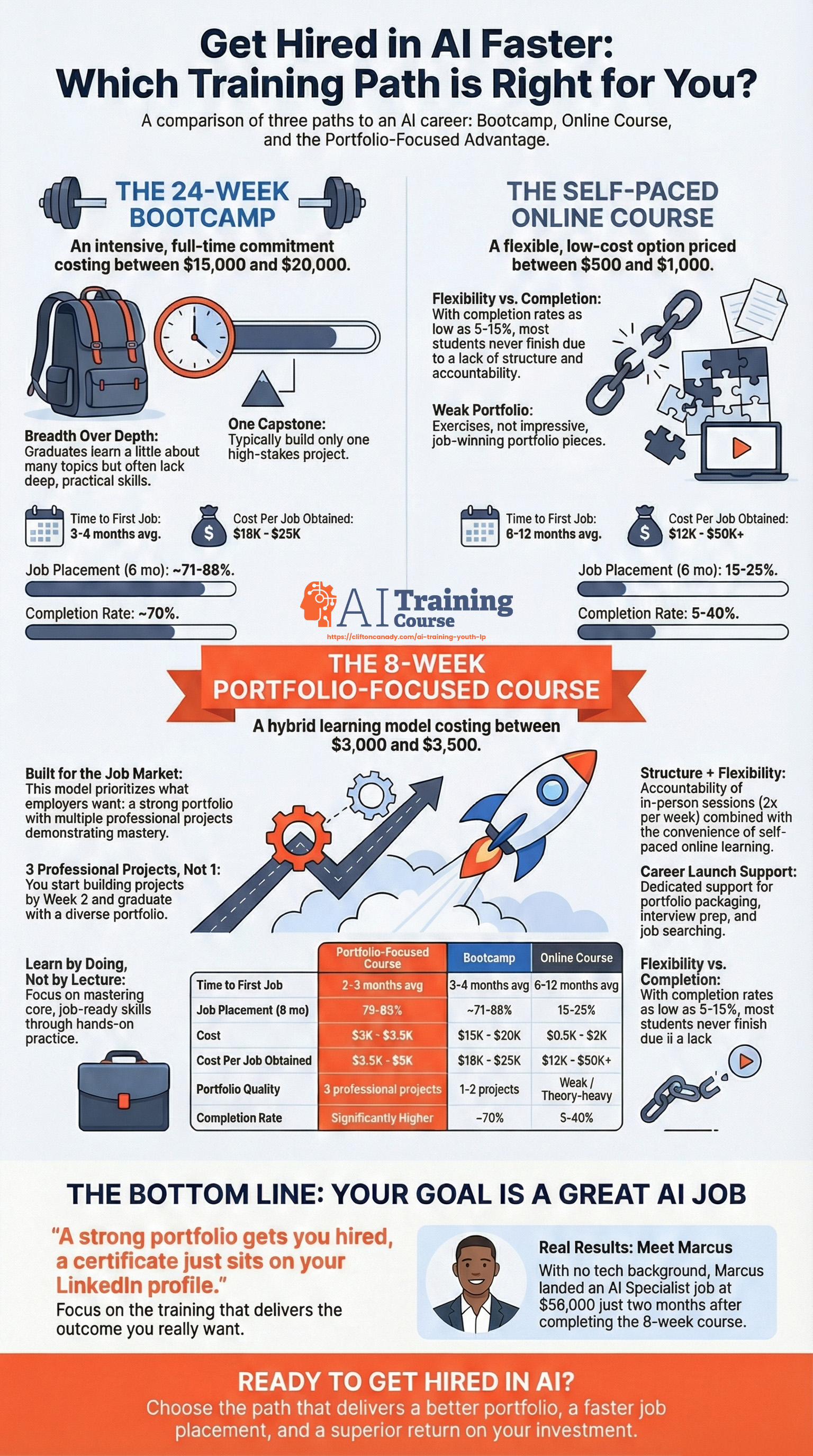
The portfolio-focused model wins on:
- Better job outcomes than online learning
- Lower cost than bootcamps (40-75% cheaper)
- Faster to employment than both
- Better portfolio quality than either
- Superior cost per job obtained
- Higher completion rate than online learning
Why This Matters: Your Actual Goal
Here’s what frustrates me most. Education marketing has made people obsess over credentials and bootcamp prestige. But your actual goal isn’t to have a shiny diploma. It’s to:
- Get hired for an AI job that pays well
- Succeed in that job once hired
- Continue growing in your AI career
Portfolio-focused training directly addresses these goals. A bootcamp certificate? That just sits on your LinkedIn profile. Your three impressive projects? Those actually get you interviews and hired.
A bootcamp might get you hired faster (but at higher cost). Online courses are cheap but don’t prepare you well. Portfolio-focused training balances cost, preparation, outcomes, and time.
Making the Right Choice
Look, I know the bootcamp route is attractive. It’s intense, it’s structured, it comes with a label and a network. There’s comfort in that. I’ve struggled with the same pull—wanting to take the “prestigious” path.
But prestigious doesn’t mean it works for your specific situation. When you’re evaluating AI training options, ask these questions instead:
1. Will I actually finish?
- Bootcamp (structured, so yes)
- Online (unstructured, so maybe not)
- Portfolio-focused (structured but not full-time, so likely yes)
2. Will I have portfolio pieces employers want to see?
- Bootcamp (1-2 projects, maybe)
- Online (mostly exercises, no)
- Portfolio-focused (3 professional projects, absolutely)
3. Will I get support breaking into jobs?
- Bootcamp (some)
- Online (basically no)
- Portfolio-focused (explicit career launch support)
4. Will I actually learn and retain the material?
- Bootcamp (some—but breadth vs. depth problem)
- Online (some—but completion problem)
- Portfolio-focused (high—learning by doing)
5. What’s the actual cost per job obtained?
- Bootcamp ($21K-$28K)
- Online ($5K-$15K, but low completion)
- Portfolio-focused ($3.5K-$5K)
Portfolio-focused training wins most of these comparisons.
The Bottom Line
You have options. So here’s the real question: which one actually works?
Not which one is most hyped. Not which one your friend did. Not which one has the biggest marketing budget and flashiest website.
Which one actually produces job-ready professionals with strong portfolios, at reasonable cost, in reasonable time?
The answer is portfolio-focused AI training. When it’s well-designed and properly executed, it wins.
It’s not the newest approach. It’s not the flashiest. But based on both industry research and my direct experience working with students, it works. I’ve watched it consistently produce graduates who:
- Have impressive portfolios employers want to see
- Get jobs quickly after completion
- Succeed in those jobs (which means they stay employed)
- Come back to learn more (because they see the ROI)
The data supports what I’ve observed: portfolio-focused training addresses the real limitations of bootcamps and online courses. It’s not because it’s theoretically superior. It’s because it’s been built on understanding exactly where the other approaches fail.
That’s the approach that wins in the long term.
Ready to Take Your AI Career to the Next Level?
If you’re considering your AI training options and want to explore whether a portfolio-focused approach is right for you, let’s talk.
I’ve helped dozens of students move from confusion about AI careers to job-ready professionals with impressive portfolios. Every situation is different—what works for one person might not be ideal for another.
Schedule a free consultation to discuss your specific situation, your goals, and which training path actually makes sense for you.
Call: +1 (864) 252-2349
Or explore our AI training program to see if it’s the right fit.
Stay Updated
Get weekly AI insights and updates delivered to your inbox

Clifton T. Canady
WordPress Developer • AI Trainer • Content Strategist • Speaker
I help entrepreneurs and businesses build powerful digital presences through custom WordPress development, AI-driven content strategy, and engaging presentations. With 10+ years of experience, I blend technical expertise with StoryBrand messaging to create solutions that actually move the needle.
Related Articles
Claude Code Skills: How I Built an AI Company OS
I turned Claude Code skills into an 8-department, 40-agent AI Company OS that runs CT Web Design Shop daily. See the install script and org chart I actually use.

The Real Barrier to Breaking Into AI (And It's Not Your Non-Technical Background)
You don't have a technical background? That's not your barrier. Here's what actually stops non-technical people from breaking into AI—and how to overcome it.

AI as a Business Tool, Not a Dependency: Building Sustainable AI Strategy
Learn how to use AI as a strategic business tool without creating dependency. The Teach and Build method aligns AI implementation with real business goals.